
Writing a Caribbean Romance: The Dominican Republic as Setting
Paradise is the laziest word on a back cover. The books that make an island work treat it the way a good historical treats a century: as part of the conflict.
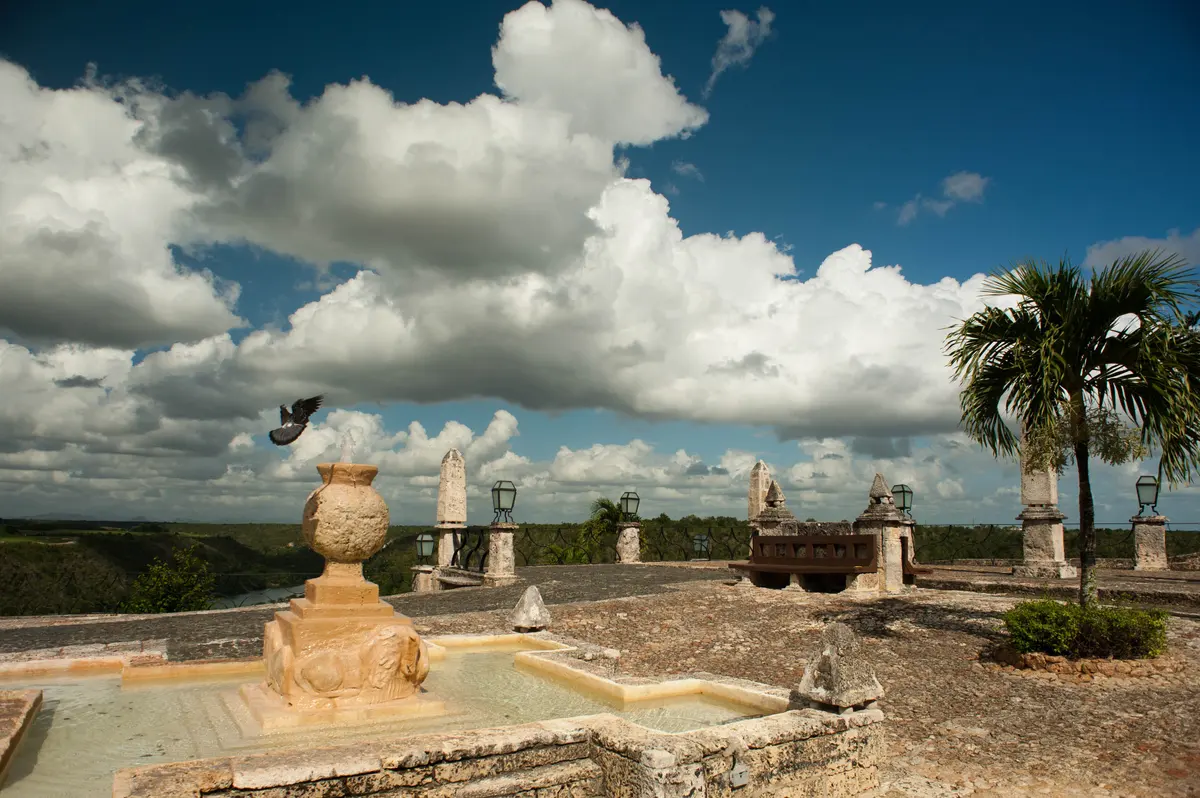
When I reviewed for the contemporary community, I came to distrust one word on a back cover: paradise. It usually meant the author had looked at a brochure. The heroine would step off a plane into warm air, someone would hand her a drink with fruit in it, and for the next two hundred pages the island would sit behind the couple like a painted backdrop in a school play, blue and green and silent.
The books I scored highest did something else. The place pushed back.
That’s what this piece is about: the Caribbean, and the Dominican Republic in particular, as a setting for romance. Not “exotic location” as decoration, which is how the old subject index filed it under EXOTIC LOCALE, but as a place with its own history and its own people, both of which can get in the way of a love story in useful ways.
What a destination romance promises
The label floats around bookshops every summer, and it is looser than most subgenre names. A destination romance takes the couple, or at least one of them, away from ordinary life. The trip is the pressure. She has ten days before her flight home. He has a contract that ends when the season does. They can’t drift, because the calendar won’t let them.
Under the label, the book is usually a contemporary, sometimes romantic suspense, and the core rules don’t change. The Romance Writers of America’s long-standing definition asks for a central love story and an emotionally satisfying, optimistic ending. The setting is a promise layered on top: you will go somewhere, and the somewhere will matter.
Category publishers understood this a long time ago. Harlequin launched the Presents line in 1973, and the imprint has always sold glamour and wealth along with the romance. If you look back at the category lines the old database tracked, you can see how often a setting was part of what a reader was buying before she ever read a blurb. A Presents reader expected a villa, a yacht or an island. She also expected the author to know what it smelled like.
That last part is where most island books fail.
The island as a third character
Writers hear “make the setting a character” so often that it has stopped meaning much. Here is what I think it means in practice. A setting is doing character work when it wants something, or when it costs the couple something.
The Caribbean offers plenty of that, if you look past the beach.
Weather has a schedule. The Atlantic hurricane season runs from June through November. A wedding booked for late September is a wedding with a contingency plan, and a contingency plan is a source of conflict. Heat is not romantic at two in the afternoon. Rain comes hard and leaves quickly.
Islands have class lines. Resort life and local life sit side by side and rarely mix. A heroine who only ever sees the inside of an all-inclusive is living in a bubble, and a hero who works there sees both sides of it every day. That gap is a better source of tension than any misunderstanding about an ex.
History is close to the surface. The Dominican Republic shares the island of Hispaniola with Haiti. Santo Domingo’s Colonial City, a UNESCO World Heritage Site since 1990, holds some of the oldest European buildings in the Americas. A character who grew up there carries that history around in a way a tourist never will.
Music is not background. UNESCO added the music and dance of Dominican merengue to its intangible heritage list in 2016, and bachata in 2019. These aren’t soundtrack choices. Bachata in particular carries decades of argument about class, respectability and who gets to dance to what. If your couple dances to it, know what you’re putting on the page.
None of this needs to be lectured. One concrete detail per scene, chosen because it affects what the characters do, is worth more than three paragraphs of travel copy.
Why the Dominican Republic works so well
It gives a writer range. In a single day’s drive you can go from the Colonial City’s stone streets to sugarcane country to resort beaches on the east coast, and up into the mountains in the centre of the island. That means your couple can change scenery without changing countries, which matters for pacing. A book that moves from a crowded city wedding to a quiet mountain town at the midpoint has built-in contrast.
It also gives you families. Dominican family life, with its cousins, godparents and opinions about everyone’s business, is a gift to a romance writer, as long as you treat it as a real family and not a comic chorus. The heroine who comes back for her sister’s wedding and finds three aunts already planning hers is a premise with energy. Make the aunts people.
And it gives you places that already look like stage sets, which brings me to the most borrowed one.
A stone village above a river
On the south-east coast, inside the Casa de Campo resort near La Romana, there’s a village that looks five hundred years old and isn’t. Work on Altos de Chavón began in 1976, when stone blasted out for a nearby road was turned into building material. The village was conceived by the Italian designer Roberto Copa and the industrialist Charles Bluhdorn, then chairman of Gulf+Western, the parent company of Paramount Pictures, and modelled on a sixteenth-century Mediterranean town of cobbled lanes and wrought-iron lamps. It sits on a bluff roughly 300 feet above the Chavón River.
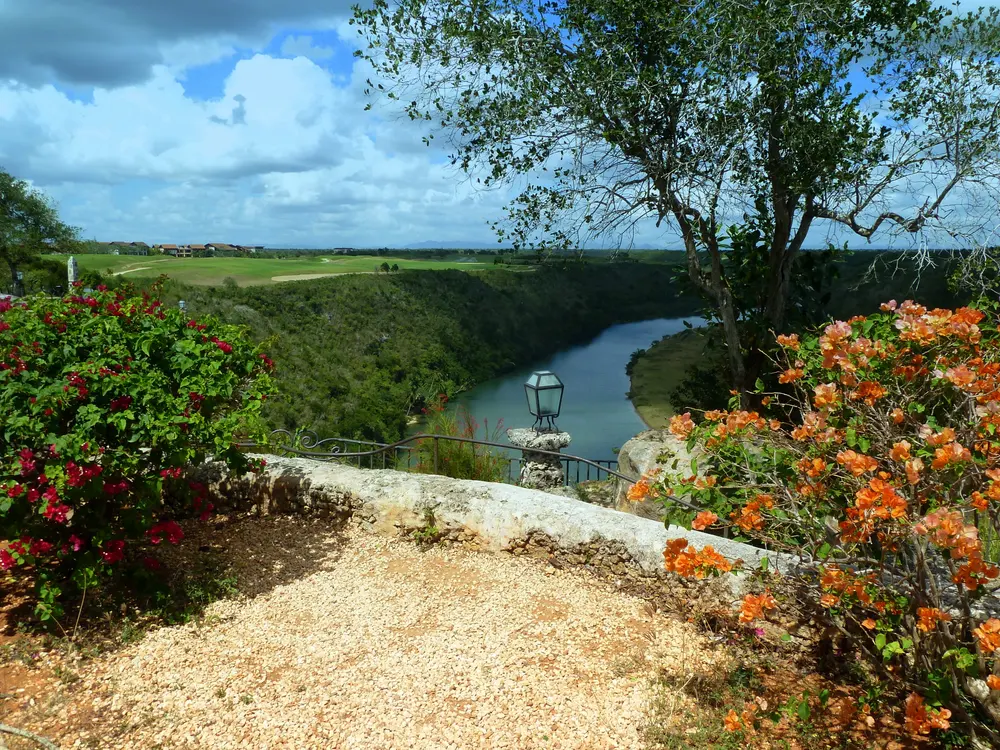
For a romance writer, it is almost too good. There is a small church, St. Stanislaus, built on the central plaza in 1979 and named for Poland’s patron saint as a tribute to Pope John Paul II, who visited Santo Domingo that year. It is one of the country’s popular wedding churches, which gives you a ceremony with a river view and a guest list that has to climb cobblestones in heels. There is a Roman-style open-air amphitheatre with 5,000 seats, opened in August 1982 with the Concert for the Americas, where Frank Sinatra headlined. There is a design school, founded in 1983 and affiliated with Parsons in New York, which means students, studios and artists’ workshops, and a reason for a heroine to be there that has nothing to do with a holiday.
If you want to see how the lanes, the church square and the river terrace fit together before you build your own version, this walk-through of Altos de Chavón, the stone village above the Chavón River covers the layout, the amphitheatre and the church where couples still marry. I’d read something like it before writing a single wedding scene there, for the plain reason that geography is where readers catch you. If your bride walks from the church to the amphitheatre in a sentence, someone who has made that walk will notice.
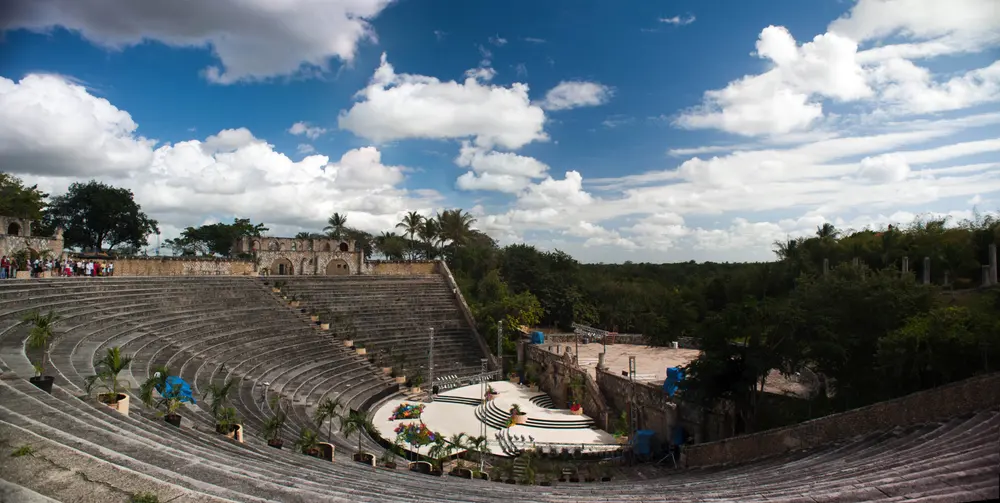
What makes the village useful, though, is the thing a careless writer would leave out: it is a built illusion. A re-creation of Europe in the Caribbean, made in living memory by an industrialist whose company owned a Hollywood studio and an Italian designer with an eye for scenery. That is a theme, if you want one. A heroine who arrives thinking the place is ancient and learns it is younger than her parents is a heroine who has just learned something about appearances, and romance runs on that discovery.
Wedding plots that travel well
Weddings and islands go together because both put strangers in close quarters with a deadline. The tropes that work best abroad are the ones the setting makes harder.
| Trope | What the destination adds | Where it goes wrong |
|---|---|---|
| Fake date for a friend’s wedding | No escape: shared villa, shared shuttle, a week of witnesses | The fake relationship has no cost once everyone flies home |
| Second chance at a family wedding | The ex is in the same small hotel, at the same rehearsal dinner | Backstory dumped on arrival instead of revealed under pressure |
| Wedding planner and the best man | Her professional reputation is at stake on foreign ground | The local vendors exist only to cause comic disasters |
| Runaway bride | A strange country makes running away literal and frightening | She runs into the arms of the first local man with a boat |
| Marriage of convenience | Residency, inheritance or a family business gives the deal teeth | The legal mechanics are hand-waved or plain wrong |
The old index had RUNAWAY BRIDE and MAIL-ORDER BRIDES/MARRIAGES OF CONVENIENCE as separate subjects in the contemporary community, which tells you readers were already hunting for these plots by name twenty years ago. What has changed is how readers judge the setting around them.
If your plot depends on a legal wedding abroad, check the current rules for foreigners marrying in the country, with official sources, while you draft. Paperwork is a plot device. Wrong paperwork is a one-star review.
What to take from a real place, and what to leave
I’ve read enough island books to have a short list of rules. They aren’t original. They are the notes I would have written in a review margin.
Take the physical facts. Distances, heights, weather, what grows where, what time the light goes. Altos de Chavón really is high above the river, and the climb really does matter to a wedding party. These are the details that make a reader trust you, the same way the right form of address makes a reader trust a Regency. Our guide to historical settings makes the same argument about periods: research is how you earn the reader’s belief, not how you show off.
Invent the private things. Staff, owners, the hotel manager with a secret, the restaurant where the hero proposes. Put your invented restaurant on a real street if you like, but don’t hang a fictional scandal on a real business.
Let local characters want things. The bartender has an exam next week. The driver is saving to open his own business. The heroine’s Dominican cousin thinks the American groom is a fool and might be right. A setting comes alive through people with their own plots, not through scenery. If you are building your leads from the archetypes readers grew up on, the piece on heroes and heroines is worth a look; the same thinking applies to your secondary cast.
Don’t make the island the cure. The heroine who arrives burnt out, falls in love and goes home healed is the most common plot in the shelf, and it treats a country like a spa treatment. Better if the island complicates her: she wants to stay and can’t, or has to go and doesn’t want to.
Check the language. Dominican Spanish has its own rhythm and vocabulary. If you don’t speak it, find a reader who does. Italicising every Spanish word marks it as foreign on every page; most current editors leave common words in roman type.
If you write across subgenres, the romance subgenres field guide shows how the same setting shifts with the promise: an island in romantic suspense is full of hiding places, while the same island in a sweet contemporary is full of chaperones.
A small test before you send it out
Take any island scene and ask three questions. Could this scene happen anywhere else with only the nouns changed? Does any local character in it want something for themselves? Does the setting make the couple’s choice harder or easier?
If the answers are yes, no and neither, the place is wallpaper. Pick one thing the setting can do to your couple, whether a storm, a family, a climb up a hill in wedding shoes, or a village that turns out to be younger than it looks, and rewrite the scene around it.
Paradise, it turns out, works better when it argues back.
Sources and further reading
- Altos de Chavón: begun in 1976 with stone from a road cut, conceived by Roberto Copa and Charles Bluhdorn, St. Stanislaus Church (1979), the 5,000-seat amphitheatre and the August 1982 Concert for the Americas, the 1983 school of design and its Parsons affiliation: Wikipedia, Altos de Chavón.
- The village’s height of about 300 feet above the Chavón River, its six-year construction and St. Stanislaus as a popular wedding church: Dominican Republic Ministry of Tourism, Altos de Chavón.
- The RWA definition of a romance novel and the stereotype of glamorous people in exotic locations: Wikipedia, Romance novel. The 1973 launch of Harlequin Presents and the imprint’s glamour-and-wealth positioning: Wikipedia, Harlequin Enterprises.
- Santo Domingo’s Colonial City on the World Heritage List since 1990: UNESCO, Colonial City of Santo Domingo. Merengue (2016) and bachata (2019) on the intangible heritage list: UNESCO, Music and dance of Dominican bachata.
- The Atlantic hurricane season, June 1 to November 30: NOAA National Hurricane Center.