
Plotting a Romance Novel: Beats, Conflict and the Ending
A romance has two fixed points, the meeting and the ending, and the craft lives in everything you build between them.
Every romance novel ever published has the same ending, and that is the best thing about the genre for anyone who wants to learn to plot.
You know where you are going. The reader knows where you are going. The suspense comes from the road, and the road is yours to build. I have read close to a thousand romances for the old review pages here, written two of my own (both currently living in a drawer under the printer paper), and the plotting problems I see over and over have little to do with the ending. They come from writers who trust the ending to do work it can’t do on its own.
This piece walks through the structure the way I wish someone had walked me through it in 2004, when I first tried to turn a pile of scenes into a book.
The two rules you don’t get to break
The Romance Writers of America, founded in Houston in 1980, settled on a short definition, and it has held up: a romance has a central love story and an emotionally satisfying, optimistic ending. Everything else is negotiable. Setting, heat level, point of view, number of corpses, whether there is a dragon. Those two are fixed.
“Central” carries more weight than people expect. The relationship has to be the spine of the book. If you can lift the love story out and the rest of the plot still stands, you have written a mystery or a family saga with a romantic subplot. That can be a fine book. It will disappoint the reader who picked it up from the romance shelf, and those readers write reviews. I used to write some of them.
“Emotionally satisfying and optimistic” leaves room. Happily ever after with a wedding and a baby epilogue qualifies. So does a quieter happy-for-now ending where two wary people decide to try. The ending has to feel earned, and it has to leave the reader believing these two will still be together when the book is closed.
If you want the long version of how the subgenres bend those rules without breaking them, the romance subgenres field guide covers it shelf by shelf.
The meeting: cute, ugly, or already over
The first meeting sets the tone for the whole book, so it deserves more thought than it usually gets.
The meet-cute is the classic: a collision, a mix-up, a shared cab, a spilled drink. It signals charm and tells the reader the book will be fun. Its weakness is that it can be weightless. Two people bump into each other, smile, and the scene has given you nothing to push against.
The meet-ugly starts the couple off on the wrong foot, and I think it is the stronger tool for most writers. Jennifer Crusie’s Bet Me (St. Martin’s, 2004) opens with Cal Morrisey approaching Min Dobbs in a bar because of a bet with her ex, David, and Min has overheard enough to know it. She agrees to dinner anyway, purely to make him regret it. Every scene that follows has friction built in, and the friction is funny. Crusie gets three hundred pages of tension out of that one overheard sentence.
The third option, which people forget, is the couple who already know each other: second-chance romance, friends to lovers, the ex-husband who turns up at the funeral. Here the “meeting” is a reunion, and the past does the work a meet-ugly would do. Nora Roberts returned to reunion plots many times across her Silhouette years, and the books work because the old wound is already open when the story starts.
Pick the meeting that creates the most useful problem. A useful problem is one the characters can’t walk away from.
Conflict: the outside force and the inside lie
Romance writers talk about two kinds of conflict, and most weak manuscripts I’ve critiqued have only one.
External conflict is the situation keeping the couple apart. A custody battle, a feud between families, a ranch that only one of them can own, a killer. It is visible, it can be described in a sentence, and it often drives the plot events.
Internal conflict is the belief each character holds that makes love feel dangerous. The heroine who decided after her father left that men don’t stay. The hero who thinks he wrecks everything he touches. It is private, it can take the whole book to surface, and it is the reason the romance takes 300 pages instead of thirty.
Julia Quinn’s The Duke and I (2000) shows how the two fit together. The external setup is a fake courtship between Simon Basset and Daphne Bridgerton, arranged so he can dodge matchmaking mothers and she can attract better suitors. The internal conflict is Simon’s vow, born of his father’s cruelty, never to have children. The fake courtship gets them into the same ballrooms. The vow keeps them apart after they marry. Quinn needed both, and she knew which one would carry the second half.
A quick test I use on my own drafts and on critique swaps:
| Question | If the answer is “no” |
|---|---|
| Could a stranger summarise the external conflict in one sentence? | The plot will feel vague; sharpen the situation. |
| Does each lead hold a private belief that makes loving the other risky? | You have a misunderstanding, not a conflict. |
| Does the external problem press on the internal belief? | The two conflicts are running on separate tracks. |
| Can the couple’s choices, rather than luck, resolve both by the end? | The ending will feel handed to them. |
The third row is the one people skip. The best external conflicts are chosen because they poke the wound. If your heroine fears abandonment, give her a hero whose job takes him away for months at a time. Now the plot and the character argument are the same argument.
The heroes and heroines essay goes further into building those private beliefs so they don’t read like a therapist’s case file.
The shape of the middle
Most romances follow a rough rhythm, whatever the length. I’ll give it as a sequence of beats because that is how I plan, but treat the percentages as loose.
- Setup and meeting (first 10 to 15 percent). Show each lead’s life before the other arrives, then bring them together with friction.
- Forced proximity and resistance (to about 35 percent). Something keeps them in each other’s orbit: a job, a snowstorm, a fake engagement. They resist the attraction for reasons the reader understands.
- Deepening (to about 50 percent). Small intimacies. A secret shared, a kindness noticed, often a first kiss or first love scene.
- The midpoint shift. Something changes the terms of the relationship.
- Rising stakes (to about 75 percent). The closer they get, the more the internal fear wakes up.
- The black moment. It all falls apart.
- The grand gesture and resolution. One or both of them changes, acts on it, and the ending arrives.
The midpoint
The midpoint is the beat new writers underestimate. Halfway through, the relationship should change category. Enemies become lovers. A fake engagement becomes a real marriage. A fling becomes something neither of them planned. In The Duke and I, the midpoint is the marriage itself: Simon and Daphne go from pretend courtship to husband and wife, and the book’s question changes from “will they get together” to “can they stay together with this secret between them.”
If your middle sags, look for the midpoint first. Usually it is missing, and the book is repeating the same stage of the relationship for 20,000 words.
The black moment
Around three quarters of the way in, the relationship breaks. This is the “black moment,” and it is the scene readers remember.
The black moment works when it grows out of the internal conflict. The hero’s fear of hurting people makes him walk away at the worst moment. The heroine’s distrust makes her believe the lie she overhears. It fails when it is a coincidence or a misunderstanding a single honest conversation would clear up. I have read too many books where the black moment hinges on someone seeing the hero hug a woman who turns out to be his sister. Readers have been seeing that hug since the 1970s. They no longer buy it, and neither do I.
Linda Howard handles this well in her suspense novels, because she can stack the external danger on top of the emotional break. In Mr. Perfect (2000) the threat to Jaine Bright and the strain in her relationship with Sam Donovan escalate together, so the reader feels both at once. You don’t need a murderer to do the same thing. You need the outside pressure peaking at the moment the inside fear is loudest.
The grand gesture
The grand gesture is the proof of change. The character who was wrong, often the one whose fear caused the black moment, does something that costs them and shows the other person they have become someone who can stay.
Grand gestures go wrong in two ways. They can be too big (the airport sprint, the public proposal on the jumbotron) and feel like spectacle with no connection to character. Or they can be too small, a mumbled apology that resolves 80,000 words of tension in one paragraph. The best gestures are specific to the wound. If he never let anyone see his home, he brings her there. If she always ran, she stays.
Two points of view, one rhythm
Most contemporary and historical romance now uses dual point of view, alternating between hero and heroine. That gives you dramatic irony (the reader knows both hearts) and a pacing problem.
The old rule of thumb is that whoever has the most to lose in a scene gets the POV. I’d add one more: don’t let the reader learn the same emotional beat twice. If she realises she is falling for him in chapter eight, and then he realises the same thing in chapter nine in a scene that repeats the beat from his side, you have spent two chapters on one development. Give him a different realisation, or skip to the consequence.
Rough balance matters less than people think. Plenty of successful books give the heroine sixty percent of the page count. The hero needs enough time on stage that his change at the end is believable. If he has three POV scenes and then a grand gesture, readers will feel the jump.
Some category lines historically leaned toward heroine-only POV, and a few authors still write that way. It makes the hero more mysterious and the black moment more painful, because the reader can’t see his side.
Where subplots belong
A subplot should do one of two jobs: put pressure on the romance, or mirror it.
Pressure subplots are the business that’s failing, the sister in trouble, the town council that wants the heroine’s bakery gone. They create situations that force the couple into decisions. Mirror subplots show another relationship, often a secondary couple, that comments on the main one. Many series authors use the secondary couple to set up the next book, which is fine as long as they don’t steal the ending.
Place subplot scenes where the main romance needs a breath. After a big emotional beat, a subplot scene lets the reader absorb it. Before the black moment, a subplot can tighten the screws. Don’t open with subplot, and don’t let a subplot resolve after the romance does. The last strong emotion in the book belongs to the couple.
Length changes the shape
A category romance and a single title use the same beats at very different scales, and writers moving between them often misjudge it.
| Category (around 55,000 words) | Single title (around 100,000 words) | |
|---|---|---|
| Subplots | One, small and tightly tied to the couple | Several, including secondary romances |
| POV characters | Usually the two leads only | Leads plus occasional villain or secondary POV |
| Setup | Meeting within the first chapter or two | Can spend a few chapters on world and backstory |
| Conflict | Mostly internal, simple external frame | Room for a complex external plot |
| Pacing feel | Close focus, every scene on the couple | Wider canvas, slower burn possible |
Category books, the slim numbered paperbacks Harlequin and Silhouette released every month, reward economy. Each line had its own expectations about heat and length, and the category romance lines guide lists the main ones. You can’t afford a scene that doesn’t touch the relationship.
A single title gives you room for a full suspense plot, a family, a town. Roberts’s single titles like Montana Sky (1996) run three half-sisters and their romances against a killer on the ranch, which no category word count could hold. The beats are still there, but each one stretches across several chapters, and the midpoint might be a cluster of scenes rather than a single turn.
When people move from category to single title, they often just add words to every scene. The result reads padded. Add story instead: a subplot, another POV, a larger external problem.
Putting the beats on paper
You can plot in your head. I did for my first manuscript and paid for it with a 40,000-word rewrite.
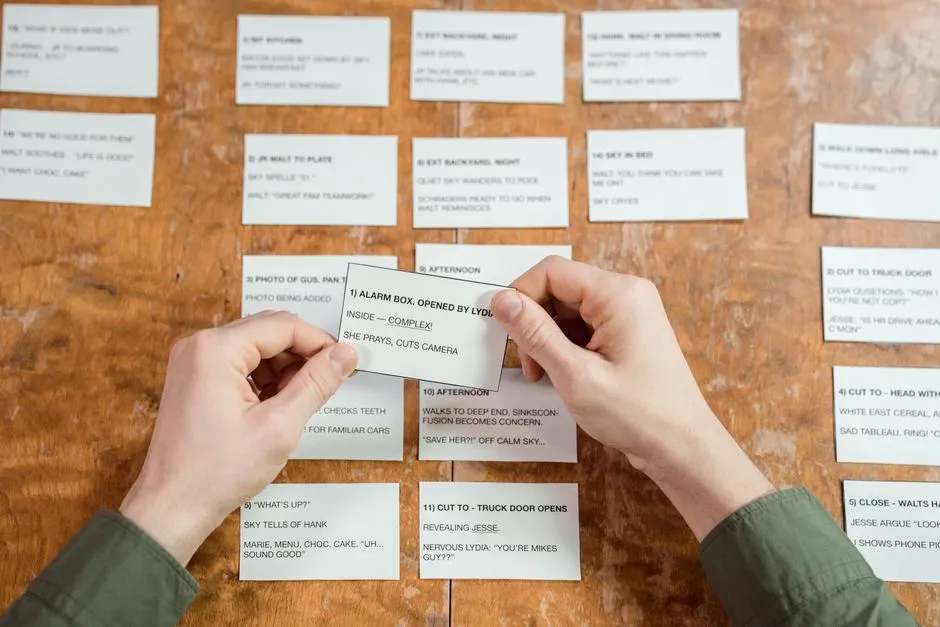
Before drafting the second one, I wrote out a scene list: one line per scene, whose POV, what changes between the two of them, and which beat it serves. It took two evenings. I found a missing midpoint and a black moment that relied on a coincidence, both before I had written a page of prose. If index cards and spreadsheets aren’t your thing, a simple outline builder can lay the beats out in order and show you where the middle goes flat. The tool matters less than the habit of seeing the whole shape before you commit to sentences.
A scene list for a romance should answer, for each line:
- Who is in the scene, and whose head are we in?
- What does the relationship look like at the start, and at the end?
- Which conflict, internal or external, does the scene push?
If the relationship is the same at both ends of a scene, the scene probably has a different job (a subplot, a clue, a breather) or it needs cutting. That one question has saved me more revision time than any craft book on my shelf.
The outline doesn’t have to be rigid. Mine changed a dozen times during the draft. What it gave me was a map, and maps are useful when you are lost in chapter fourteen at one in the morning.
The ending is a promise you keep in the first chapter
Readers know the couple will end up together. That knowledge changes what they read for. They watch for the moment she trusts him, the moment he drops the act, the moment both of them choose this over safety. A plot that delivers those moments in an order that builds is a plot that works, even if the external events are familiar.
So plant the ending early. If the grand gesture is him finally telling the truth about his brother’s death, the reader should see him dodge the subject in chapter two. If the heroine’s final choice is to stay in the town she has been trying to leave, she should be counting the days to her departure on page ten. The last chapter pays off the first.
When you finish a draft, swap it with someone who reads the genre and ask them where they stopped believing. Our guide to finding a critique partner covers how to set that up without losing a friend. The answer to “where did you stop believing” is almost always a structural answer, and with this map in hand you’ll know which beat to fix.
Sources and further reading
- The Romance Writers of America’s founding in Houston in 1980 and its requirement of an “emotionally satisfying and optimistic ending”: Wikipedia, Romance Writers of America.
- Bet Me published by St. Martin’s in 2004, with Min overhearing the bet between Cal and David: Wikipedia, Bet Me.
- The Duke and I published by Avon in 2000, with Simon’s pretend courtship of Daphne and his warning that he can never have children: Wikipedia, The Duke and I.
- Montana Sky (1996) and its three half-sisters inheriting their father’s Montana ranch: Wikipedia, Montana Sky.